Vibe Coding vs.
  Agentic Engineering: Choosing the Right Approach for AI-Assisted Software Development
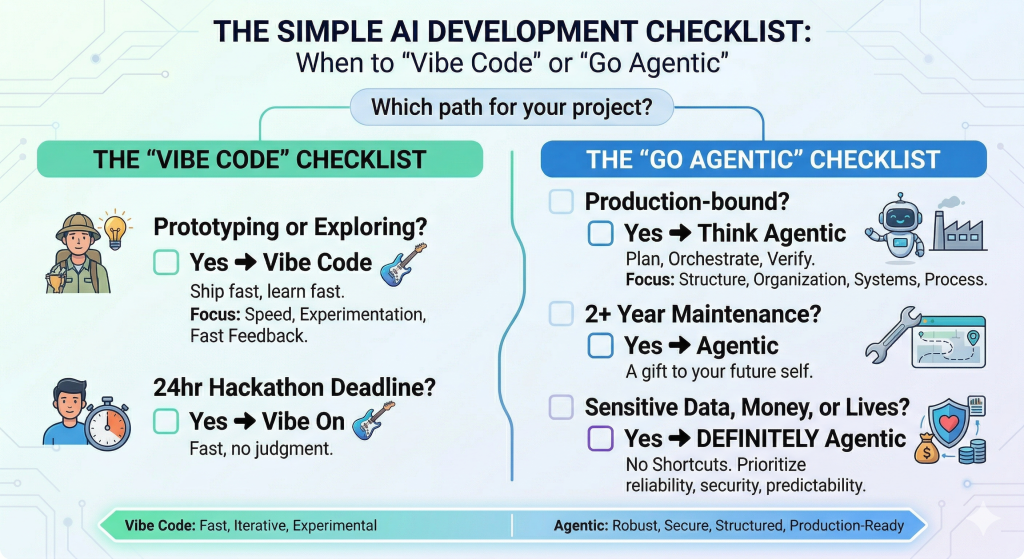
If you’ve been anywhere near a dev community in the last year, you’ve probably heard the term “vibe coding.” Maybe you’ve even done it — spinning up a full app by just chatting with Claude or Copilot, hitting accept-all, and watching something appear like magic. 
But there’s a new term quietly taking over engineering circles: Agentic Engineering.
These two ideas represent a fundamental fork in how we think about AI-assisted development. One is a creative superpower. The other is an engineering discipline. And confusing them — or using the wrong one at the wrong time — can lead to some seriously painful results.
Let’s break it down.
What is Vibe Coding?
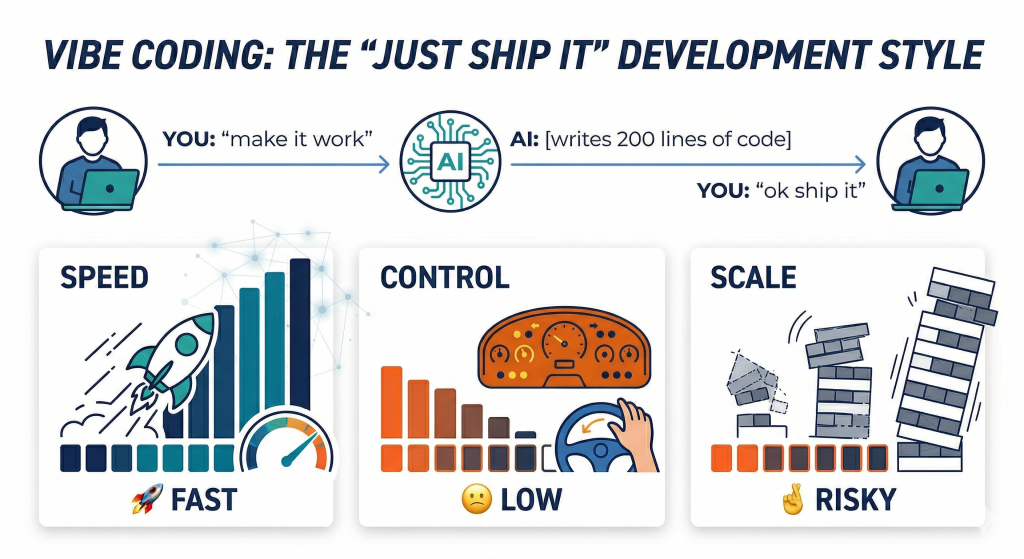
Vibe Coding is exactly what it sounds like.
You open a chat window. You type something like “build me a dashboard that shows my GitHub activity”. The AI writes the code. You skim it (maybe). You accept it. You ship it.
No architecture docs. No test plan. Just pure flow state between you and the model.
The term was popularized in early 2025 and quickly went viral because, honestly? It feels incredible. You go from zero to working prototype in minutes. It democratized software creation for non-developers and supercharged experimentation for experienced ones.
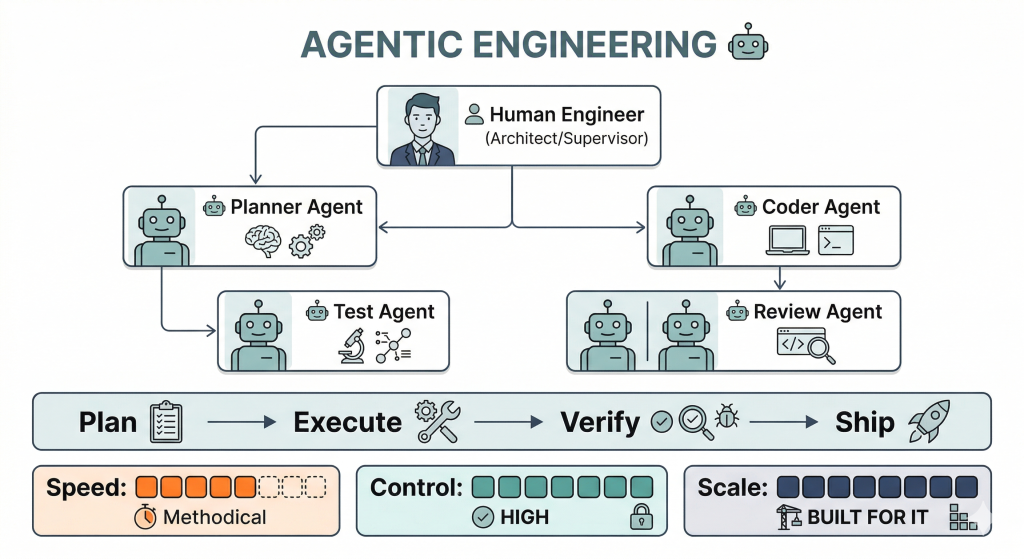
Agentic Engineering shines when:
-
 You’re building production-grade software
 -
 Security, compliance, or reliability is critical
 -
 The codebase is large and complex
 -
 Multiple people (or agents) need to collaborate
 -
 You’re shipping something that needs to last
 Head-to-Head: The Real Differences
|
|
|
|
|---|---|---|
|
Your Role |
Prompt writer, creative driver |
Architect, supervisor, reviewer |
|
AI’s Role |
Assistant on demand |
Autonomous, goal-driven agent |
|
Workflow |
Conversational, unstructured |
Planned, structured (Plan → Execute → Verify) |
|
Best For |
Demos, prototypes, experiments |
Production, enterprise, scale |
|
Code Review |
Minimal (“accept all”) |
Rigorous, multi-level |
|
Test Coverage |
Usually an afterthought |
Built into the loop |
|
Tech Debt |
Accumulates fast |
Managed systematically |
|
Learning Curve |
Very low 🟢 |
Higher 🟡 |
|
Speed to MVP |
|
|


 Very fast
 Measured
Done in 45 minutes. Feels great.
Three weeks later: a security researcher finds a token validation bug. The codebase is a maze of AI-generated spaghetti. Fixing it takes days.
Three weeks later: the system handles a traffic spike gracefully. Zero security incidents