
In the hyper-accelerated business environment of 2026, the traditional “linear” sales funnel is dead. Today’s market leaders recognize that sales isn’t a standalone department, it’s a data-driven ecosystem that must be connected to inventory, finance, and customer service in real-time.
For many organizations, the sales process remains a fragmented journey across spreadsheets, legacy CRMs, and manual email threads. This fragmentation leads to process friction, the silent killer of growth. However, a new standard has emerged. Top global players, from manufacturing giants like Toyota to retail powerhouses like Del Monte, have moved away from “Frankenstein” software stacks in favor of comprehensive sales automation. At the heart of this digital transformation is Odoo ERP.
In this blog, we will explore the granular strategies these companies use to automate sales quotes, eliminate bottlenecks, and scale revenue without increasing headcount.
The Death of the “Data Silo” through Sales Automation
The “Data Silo” refers to the isolation of information within a single department. For a sales team, this usually means they can see a lead’s contact info but have no visibility into whether the warehouse can fulfill the order or if the accounting department has flagged the client for late payments.
The Unified Source of Truth
Leading firms use Odoo’s single-platform architecture to achieve total sales quote automation. When a sales rep creates a quotation in Odoo, the system executes a multi-point synchronization that used to take hours of manual checking:
- Real-Time Inventory Synchronization: The moment a product is added to a quote, Odoo checks “Virtual Stock” (on hand minus already committed orders). This prevents the “overselling” of out-of-stock items, which is a primary cause of customer churn.
- Automated Margin Calculation: Finance rules and tax positions are baked into the price list. If a rep tries to offer a discount that drops the margin below a certain threshold, Odoo’s sales automation can automatically trigger a manager approval workflow.
- 360-Degree Customer View: Before picking up the phone, the rep sees a “Customer Snapshot.” This includes every past interaction, active support tickets, and even their payment habits. If a client is notorious for 60-day late payments, the rep can proactively adjust the terms on the quote.
By integrating Sales, CRM, and Inventory, companies like Sodexo have reported reducing administrative overhead, allowing their teams to spend more time selling and less time searching for data.
Speed to Market: The Power of Sales Quote Automation
In 2026, “Speed to Lead” is the most important metric in B2B and B2C sales. Research shows that the first vendor to provide a professional, accurate quote has a 60% higher chance of winning the deal. This is where sales quote automation becomes a massive competitive advantage.
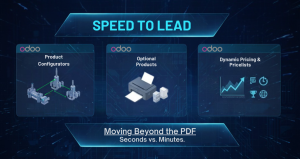
Moving Beyond the PDF
In Odoo, top businesses automate sales quotes by using pre-configured templates and dynamic pricing rules. In a legacy system, a rep might spend 30 minutes formatting a PDF, attaching terms and conditions, and calculating shipping. In Odoo, this happens in seconds.
Key Features of Sales Quote Automation:
- Product Configurators: For companies selling complex products (like custom machinery or tailored furniture), Odoo’s configurator ensures that reps only select compatible components. This eliminates “impossible” orders that the production team can’t fulfill.
- Optional Products (The “Amazon” Effect): Odoo’s sales quote automation allows you to suggest optional products directly on the web-based quote. If a customer is buying a printer, the quote automatically suggests ink and paper. This increases the Average Order Value (AOV) without any extra effort from the salesperson.
- Dynamic Pricing & Pricelists: Whether it’s a “Black Friday” sale, a loyalty discount for a VIP client, or a currency-specific price for an international lead, Odoo handles the math automatically. Reps no longer have to consult a 50-page price manual.
Mastering the “Quote-to-Cash” (Q2C) Pipeline
The Quote-to-Cash process is the most critical stage of the sales cycle. Delays in signing or invoicing create “deal fatigue,” where the buyer’s excitement wanes. Odoo streamlines this through a seamless, automated chain of events.
The Odoo Workflow:
Top businesses follow this high-velocity workflow to ensure no revenue leaks:
- Automate Sales Quotes with e-Sign: Instead of “Print, Sign, Scan,” Odoo sends a secure link. Customers can sign via Odoo Sign on any device. This legal, encrypted signature instantly updates the document status to “Fully Signed.”
- Instant Billing & Payment: Upon signature, sales automation triggers the generation of the invoice. If the business uses Odoo’s payment acquirers (like Stripe or PayPal), the customer can pay immediately via credit card or bank transfer.
- Automated Logistics & Procurement: For physical goods, a confirmed sale instantly creates a “Delivery Order” in the warehouse module. If the item is out of stock, Odoo can automatically generate a “Purchase Order” to the supplier or a “Manufacturing Order” for the production team.
Leveraging AI for Predictive Sales Intelligence
By 2026, sales automation has evolved from simple “if-this-then-that” rules to complex artificial intelligence. Top-performing teams use Odoo’s AI-driven lead scoring to prioritize high-value opportunities.
How AI Streamlines the Funnel:
Odoo’s machine learning models analyze engagement metadata and historical success patterns. It assigns a “Probability of Success” score to every lead in the CRM.
- Predictive Lead Scoring: If a lead comes from a specific industry and has opened three emails in 24 hours, Odoo flags them as a “Hot” lead and notifies a senior account executive.
- Automated Nurturing: If a lead is scored as “Low Probability,” sales automation places them in a long-term email drip campaign. This ensures that no lead is “dropped,” but no human time is wasted on low-value prospects.
By choosing to automate sales quotes and lead routing, businesses ensure that their most expensive human assets (their sales stars) are only engaging with deals that are ready to close.
The Manufacturing Advantage: Linking Sales to Production
For manufacturing companies, Odoo provides a level of streamlining that separate CRMs (like Salesforce) simply cannot touch without expensive third-party integrations.
When a salesperson uses sales quote automation to sell a custom product, Odoo looks at the Bill of Materials (BoM).
- It calculates the cost of raw materials in real-time.
- It checks the production schedule to give the customer an accurate “Expected Delivery Date.”
- If the sale is confirmed, it reserves the raw materials in the warehouse so they aren’t used for another project.
This level of sales automation eliminates the “I sold it, but we can’t build it” nightmare that plagues many growing manufacturers.
Managing Global Sales with Multi-Company Environments
For enterprises like Bourbon or Kospa Logistics, sales aren’t just local; they are global. Managing different tax jurisdictions (VAT, Sales Tax, GST), multiple currencies, and localized price lists is a primary friction point.
Odoo allows top businesses to manage Multi-Company environments from a single dashboard.
- Inter-Company Rules: When a sales office in London sells a product produced by a factory in Germany, Odoo automatically creates the “Purchase Order” in the UK and the “Sales Order” in Germany.
- Automated Currency Conversion: Odoo connects with central banks to update exchange rates daily. When you automate sales quotes for an international client, the system ensures your margins are protected against currency fluctuations.
Comparative Analysis: Legacy vs. Odoo
To understand the impact of these changes, we can look at the “Before and After” of a typical mid-market company transitioning to Odoo.
The Human Element: Employee Satisfaction and Retention
An often-overlooked benefit of sales automation is the impact on the sales team’s morale. In 2026, the best sales talent wants to spend their time talking to customers and closing deals, not fighting with clunky software or doing manual data entry.
By using Odoo to automate sales quotes and repetitive tasks, businesses reduce administrative burnout. Reps feel more empowered because they have the data they need at their fingertips, and they feel more successful because the system helps them move deals through the pipeline faster.
2026 Best Practices for Your Odoo Sales Strategy
If you are looking to emulate the success of top businesses, here is a roadmap for your Odoo implementation:
Phase 1: Data Hygiene:
Before you can automate sales quotes, your data must be clean. Use Odoo’s deduplication tools to merge duplicate contacts and ensure your “Product Templates” are correctly configured with accurate costs and descriptions.
Phase 2: Implement “The Chatter”:
Encourage your team to stop using internal email for deal discussions. Use Odoo’s “Chatter” feature on every sales order. This creates a permanent, searchable audit trail of every conversation regarding that deal.
Phase 3: Mobile Enablement:
In 2026, sales happen everywhere, at trade shows, in coffee shops, and on-site at client facilities. Ensure your team is using the Odoo Mobile App. This allows them to automate sales quotes on the fly and capture signatures on their tablet or phone immediately.
Phase 4: AI Forecasting:
Turn on Odoo’s AI forecasting modules. Stop looking at “What did we sell?” and start asking “What will we sell?” This allows your procurement and production teams to prepare for surges in demand weeks in advance.
Conclusion: The Competitive Necessity of Integration
In the modern economy, streamlining is no longer a luxury; it is a survival requirement. The companies that continue to use disconnected tools for CRM, quoting, and invoicing will eventually be outpaced by those who embrace sales automation.
By adopting Odoo ERP, top businesses have turned their sales departments from slow-moving cost centers into high-velocity revenue engines. They have eliminated the “manual” from their workflows and replaced it with sales quote automation, real-time data, and AI-driven insights.
The journey to a streamlined sales process begins with a single step: recognizing that your software should work for your sales team, not the other way around. In a world where speed is the ultimate currency, Odoo provides the bridge between a customer’s initial interest and the final “Paid” status.
Stop fighting with PDFs and start closing deals faster. Contact us today and see how sales automation can transform your revenue.