
📘 Part 3 of the Agentic Engineering Series
✍️By: David Estrada | 📅Date Published: 2026/04/17
In Part 2, we saw how Agentic Engineering emerged as a direct response to the chaos of vibe coding — and why the discipline around the AI matters more than the AI itself. Now we tackle the thing that makes that discipline possible in the first place: the spec.
The Art of Thinking Before You Build — And Why AI Makes It More Powerful Than Ever
"The most expensive line of code is the one you write before you understand the problem."
There’s a quiet revolution happening in how the best engineering teams use AI — and it doesn’t start with a prompt.
It starts with a spec.
While the rest of the world is racing to prompt faster, ship faster, and iterate faster, a growing number of teams are doing something that sounds almost counterintuitive: slowing down at the start to go dramatically faster everywhere else.
That’s Spec Driven Development. And in an era where AI agents can write thousands of lines of code in seconds, it might just be the most important engineering discipline you can adopt.
Part 1: What Even Is a “Spec”? 📄
Before we go further, let’s level-set. A specification (spec) isn’t a vague requirements doc or a wall of Confluence text that nobody reads. In the context of modern software development, a spec is a precise, shared, often machine-readable description of how a system should behave.
Think of it like architectural blueprints for a building. You don’t start pouring concrete before the blueprints are done. The blueprints are the contract between the architect, the structural engineer, the electrician, and the contractor. Everyone builds from the same source of truth.
In software, specs can take many forms:
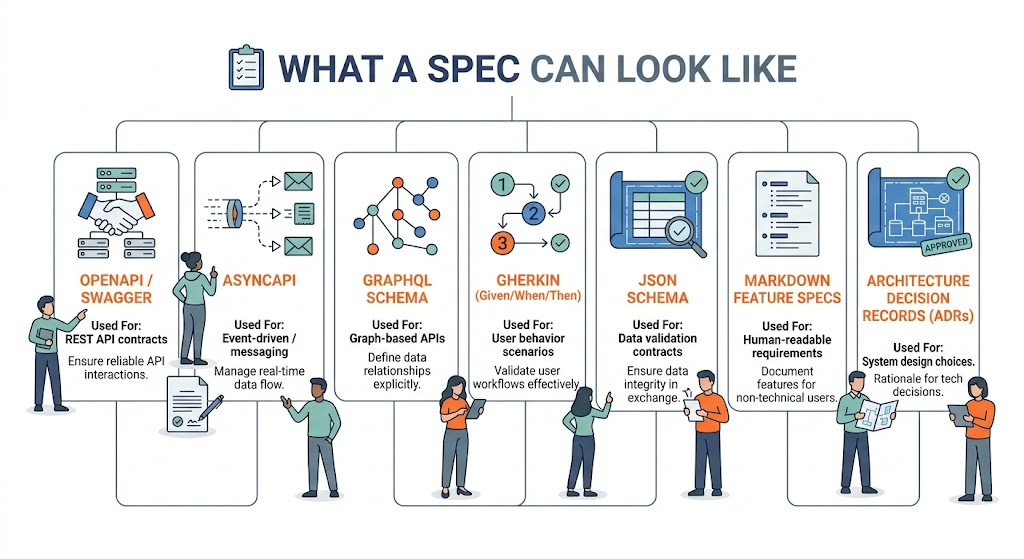
What makes a spec good is that it’s:
Unambiguous — no room for “I thought you meant…”
Testable — you can verify if the system matches it
Shared — everyone, including AI agents, reads from it
Living — it evolves with the product, not against it
Part 2: The Core Idea — Spec First, Code Second 🧠
Spec Driven Development (SDD) is exactly what it says on the tin: the specification drives everything else. Before a line of implementation code is written, before a test is defined, before a pull request is opened — the spec exists.
This one inversion of order changes almost everything downstream.
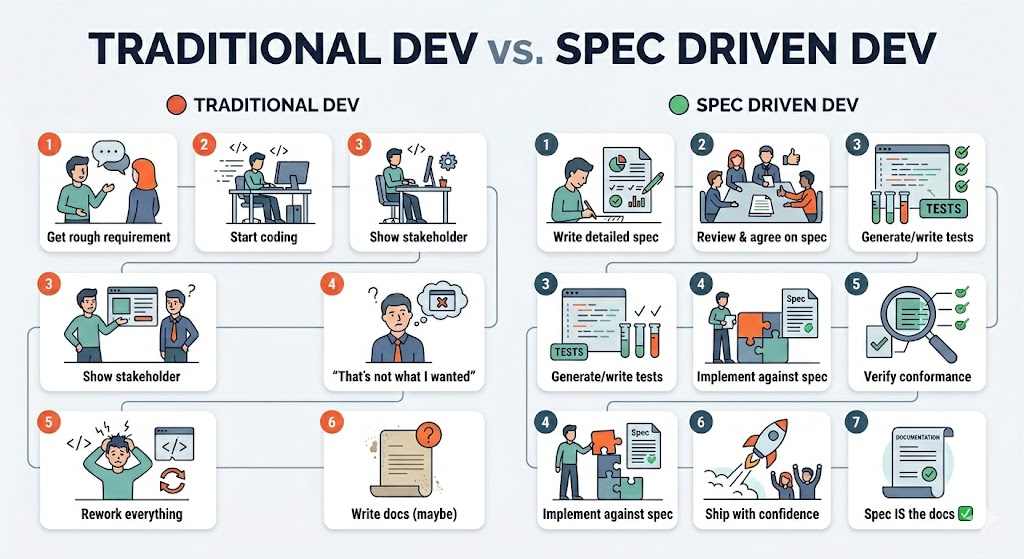
At its core, SDD is about deferring implementation until you’re confident in the design. Not forever. Just long enough to think clearly.
Part 3: The SDD Workflow in Practice 🔄
The modern SDD workflow — especially when paired with AI tooling — looks something like this:
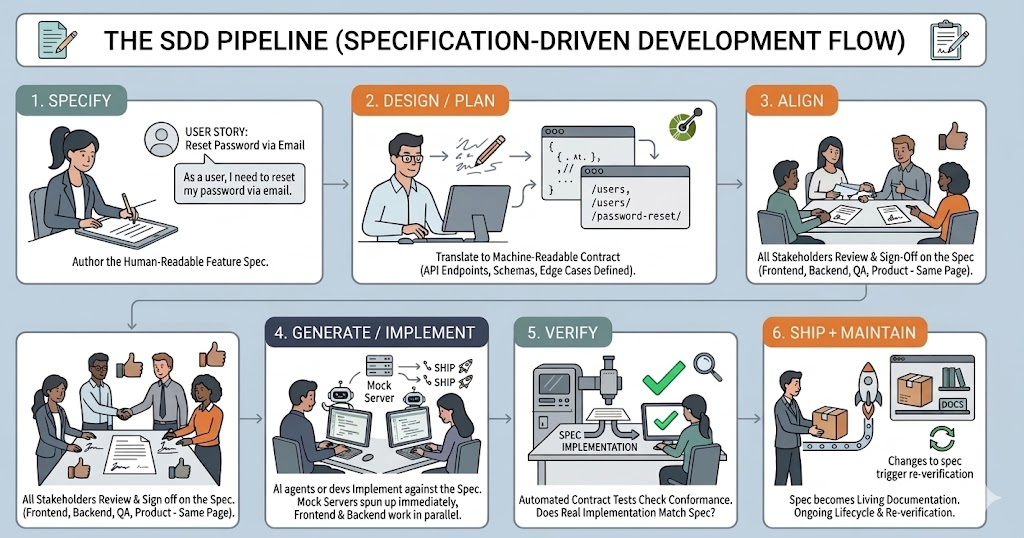
The magic is in step 4: because the spec is machine-readable, AI agents can consume it directly — generating not just code, but also tests, mock servers, documentation, and even client SDKs. All from the same source of truth.
Part 4: SDD and AI — A Perfect Partnership 🤖📋
Here’s where it gets exciting for 2025 and 2026.
AI coding assistants — whether that’s GitHub Copilot, Claude, or an autonomous agent — are fundamentally context machines. They generate better output when given better context. And nothing provides richer, more precise context than a well-written spec.
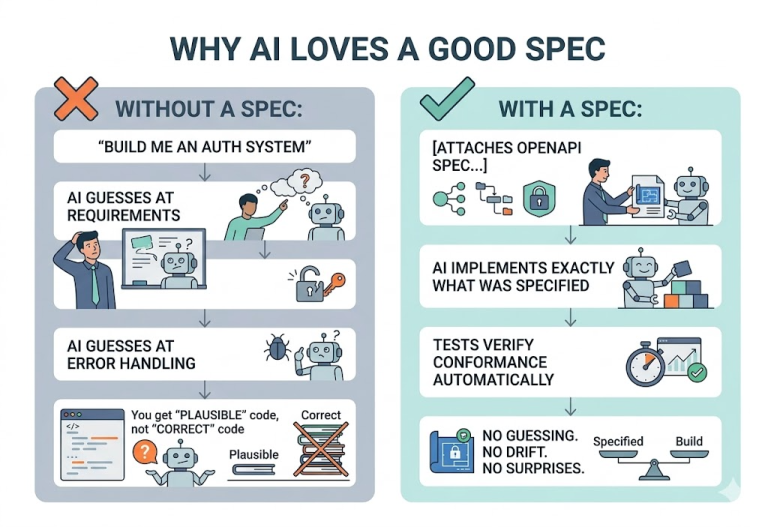
This is the insight that GitHub shipped GitHub Spec Kit around in 2025 — an open-source toolkit that formalizes the SDD workflow for AI-assisted teams. The kit introduced a structured command flow:
/specify— Draft a user-focused, non-technical feature spec in plain English/plan— Generate and refine an OpenAPI contract as the technical source of truth/tasks— Break the spec into concrete, implementable work items- Implement — Specialized AI agents (frontend, backend, test) each work from the same spec contract
The result? Parallel workstreams. No integration surprises. AI that’s building the right thing, not just a thing.
Part 5: SDD vs. Its Cousins — TDD and BDD 🥊
SDD doesn’t exist in isolation. It lives in a family of “think-before-you-code” methodologies. Here’s how they relate:
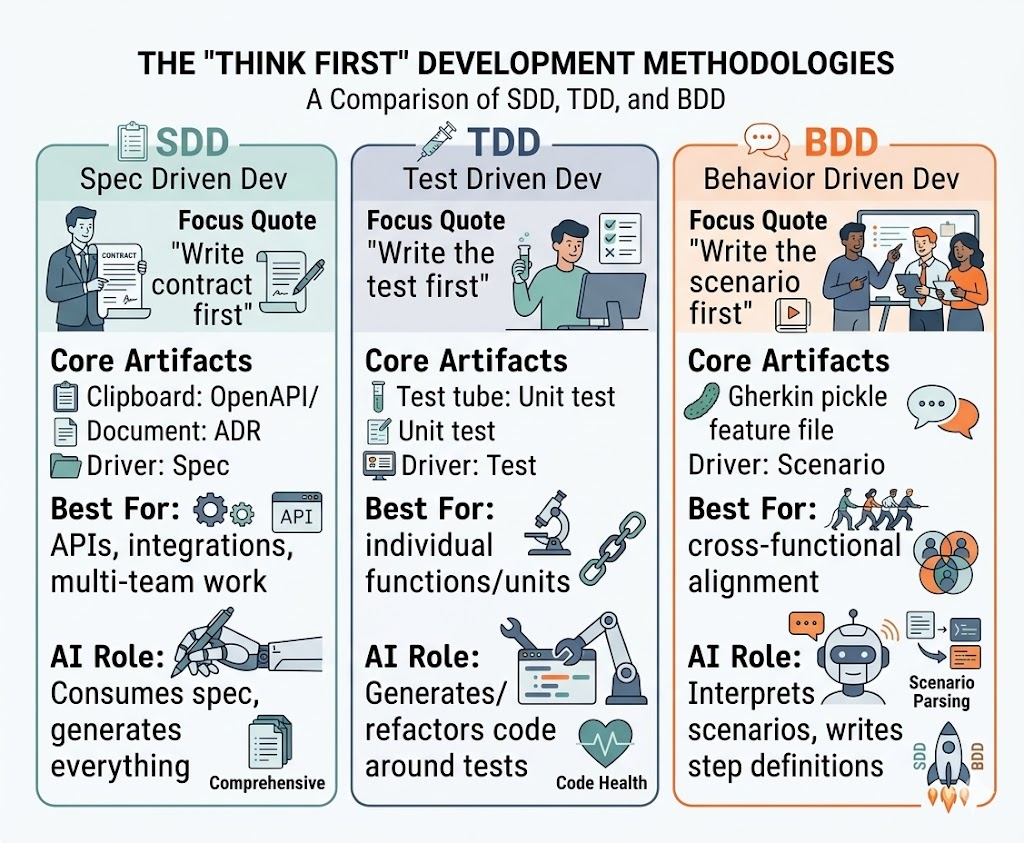
They’re not competitors — they’re complements. Many mature teams use all three:
SDD to define the system contract (what exists)
BDD to describe user behaviors (how it’s used)
TDD to implement each unit with confidence (that it works)
Think of it as three layers of a quality sandwich. SDD is the bread. It holds everything together
Part 6: Real-World SDD in Action 🏗️
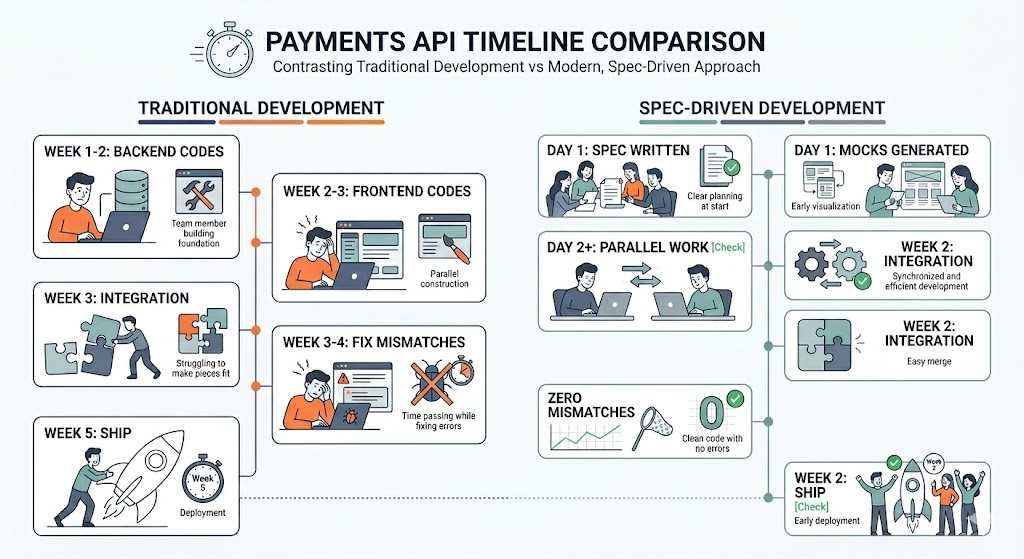
🏦 Fintech: The Payments API
A neobank is building a new payments feature. In a traditional workflow, backend starts coding endpoints, frontend starts building UI, they meet in the middle three weeks later and discover a mismatch. Two weeks of rework follow.
With SDD:
The team spends one day writing an OpenAPI spec for the payments endpoints — request/response schemas, error codes, auth requirements, rate limits.
Mock servers are generated automatically from the spec. Frontend starts building against them the same day.
Backend implements against the spec. A contract test suite runs on every commit, verifying conformance.
When frontend and backend integrate: zero surprises. The spec was the contract they both honored.
🏥 Healthcare: When Getting It Wrong Is Not an Option
A healthcare platform is adding a patient data API. The compliance requirements alone — HIPAA, audit logging, data minimization — would make a vibe-coded implementation terrifying.
With SDD, the spec encodes the compliance requirements directly:
-
Which fields are PII and must be masked
-
Exactly which endpoints require which auth scopes
-
What the audit log format must contain
-
What responses are allowed for unauthenticated requests
AI agents implement against this spec. The compliance team reviews the spec — not thousands of lines of code. Auditors get the spec as documentation. The spec is the compliance artifact.
🤖 AI Agent Orchestration: Avoiding Hallucination at Scale
One of the most compelling 2026 use cases: using specs to ground AI agents in agentic engineering pipelines.
When multiple agents are working on the same codebase, they need a shared source of truth. Without it, Agent A builds an endpoint that returns user_id as a string, and Agent B builds a consumer expecting an integer. Both are “correct” from their local context. Together, they’re broken.
With a spec? Both agents consume the same schema. Consistency is enforced structurally, not by hoping the AI “remembers” previous decisions.
Part 7: The Real Talk — Where SDD Gets Hard 😤
Let’s not pretend SDD is friction-free. It has real failure modes, and teams who’ve tried it know them well.
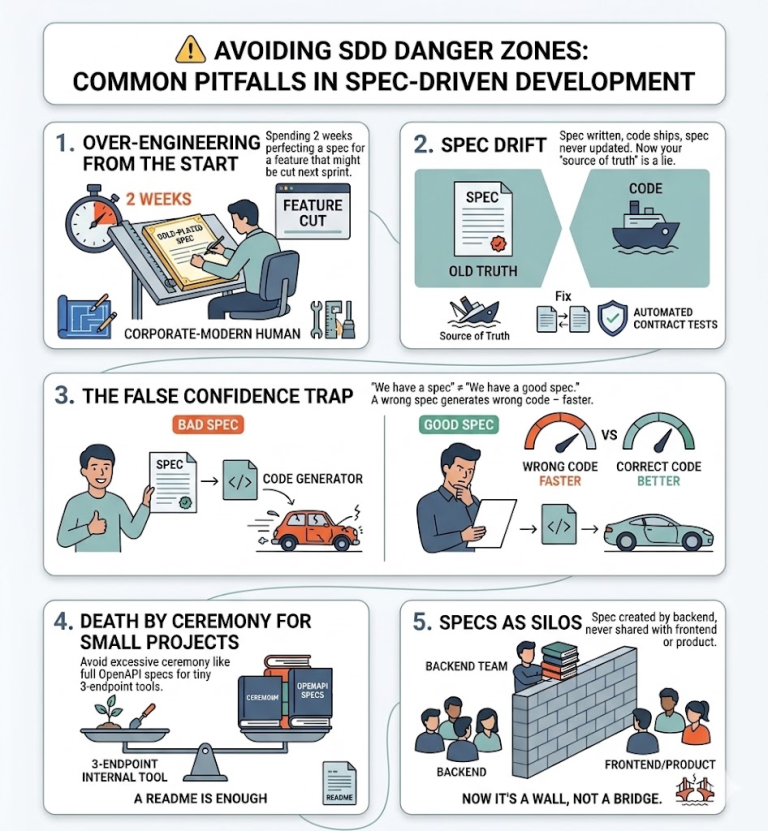
The SDD Risk Matrix
| Risk | When It Happens | How to Mitigate |
|---|---|---|
| Over-engineering | Complex specs for simple features | Use lightweight specs for low-stakes work |
| Spec drift | No enforcement between spec and code | Automated contract tests in CI |
| Wrong spec = wrong code | Poor spec quality | Stakeholder review before implementation |
| Slow initial velocity | All effort upfront | Timebox spec phase; don’t aim for perfection |
| Siloed specs | One team owns spec | Treat spec reviews like code reviews |
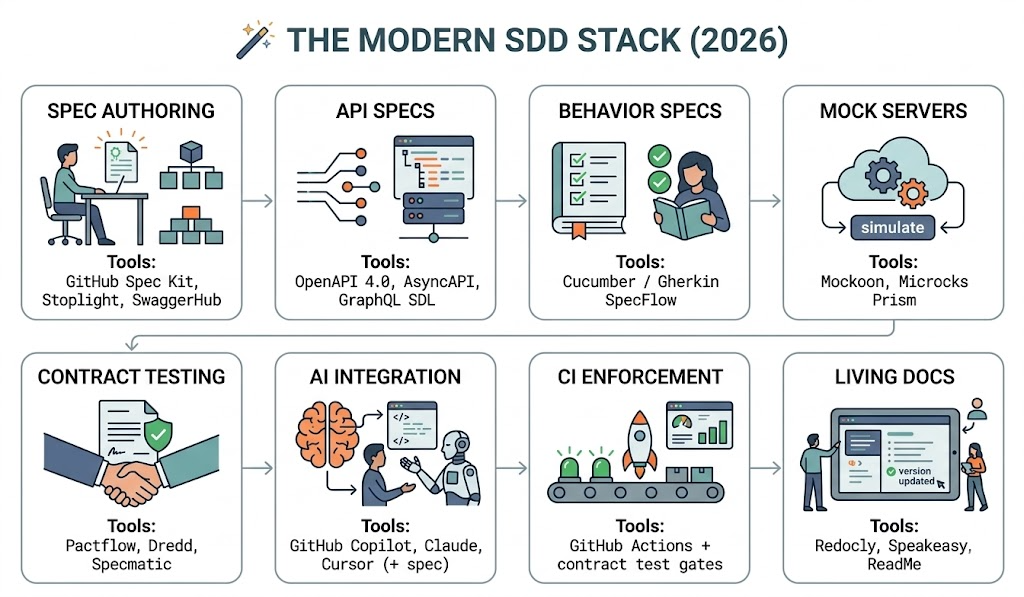
Part 8: The SDD Toolkit 🛠️
Part 9: A Day in the Life — SDD with AI 👩💻
Let’s make this concrete. Here’s what a modern SDD + AI workflow looks like on a Tuesday morning:
/specify. Drafts a plain-English feature spec in 10 minutes:
- What data is included
- What triggers the export
- What the user receives
- Edge cases (empty data, large exports, rate limits)
/plan. Spec Kit generates a draft OpenAPI contract for the export endpoint. Engineer reviews, tweaks the response schema, adds a job_id for async exports.That’s the power of SDD. The spec did 60% of the coordination work before a single line of implementation was written.
Part 10: When Should YOU Use SDD? 🚦
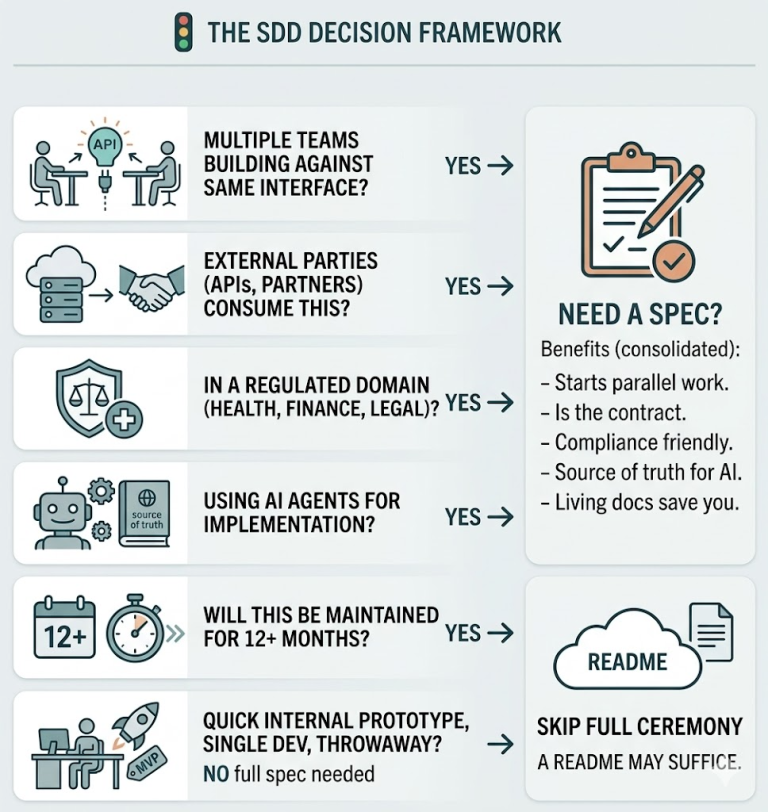
Part 11: Where SDD Fits in the Bigger Picture 🗺️
By now you might be wondering: how does SDD relate to Vibe Coding and Agentic Engineering? Think of them as a natural progression:
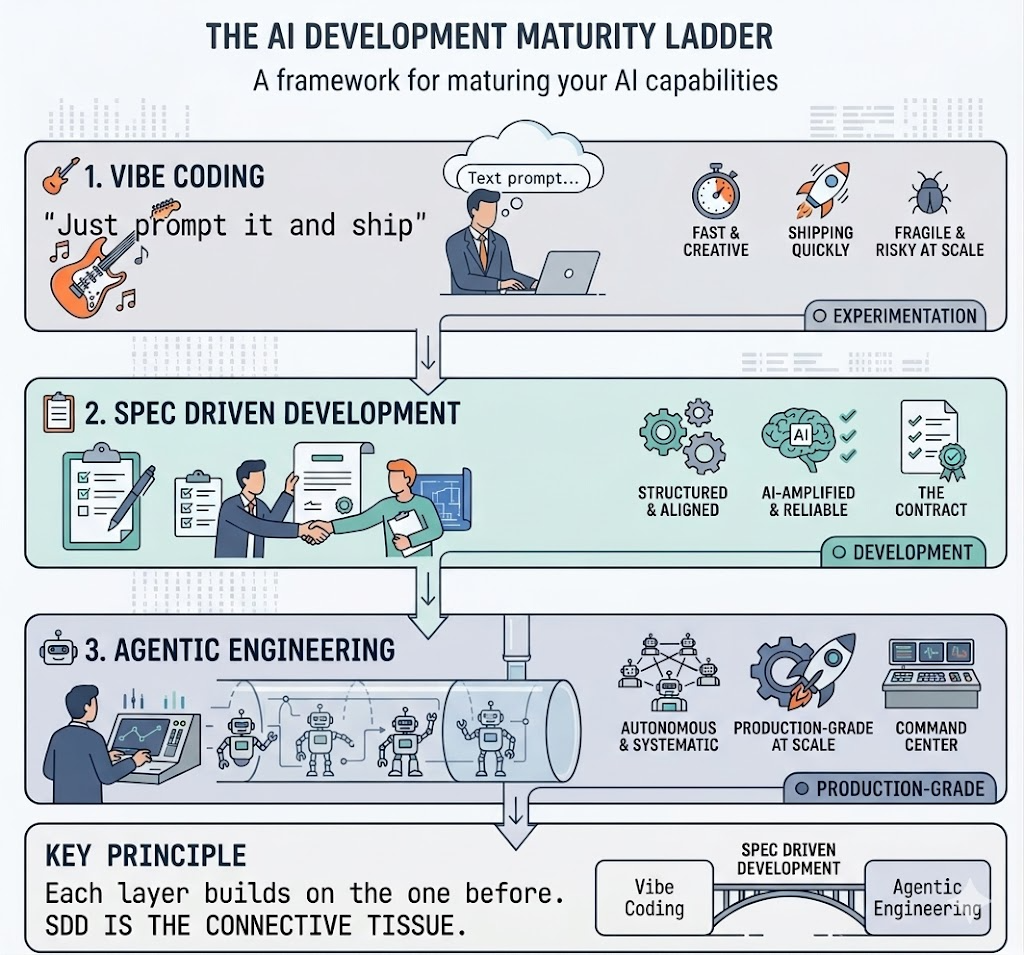
Spec Driven Development is the bridge. It takes the raw creative energy of ideation — which vibe coding is great at — and gives it enough structure to hand off to AI agents without everything falling apart.
🎯 TL;DR
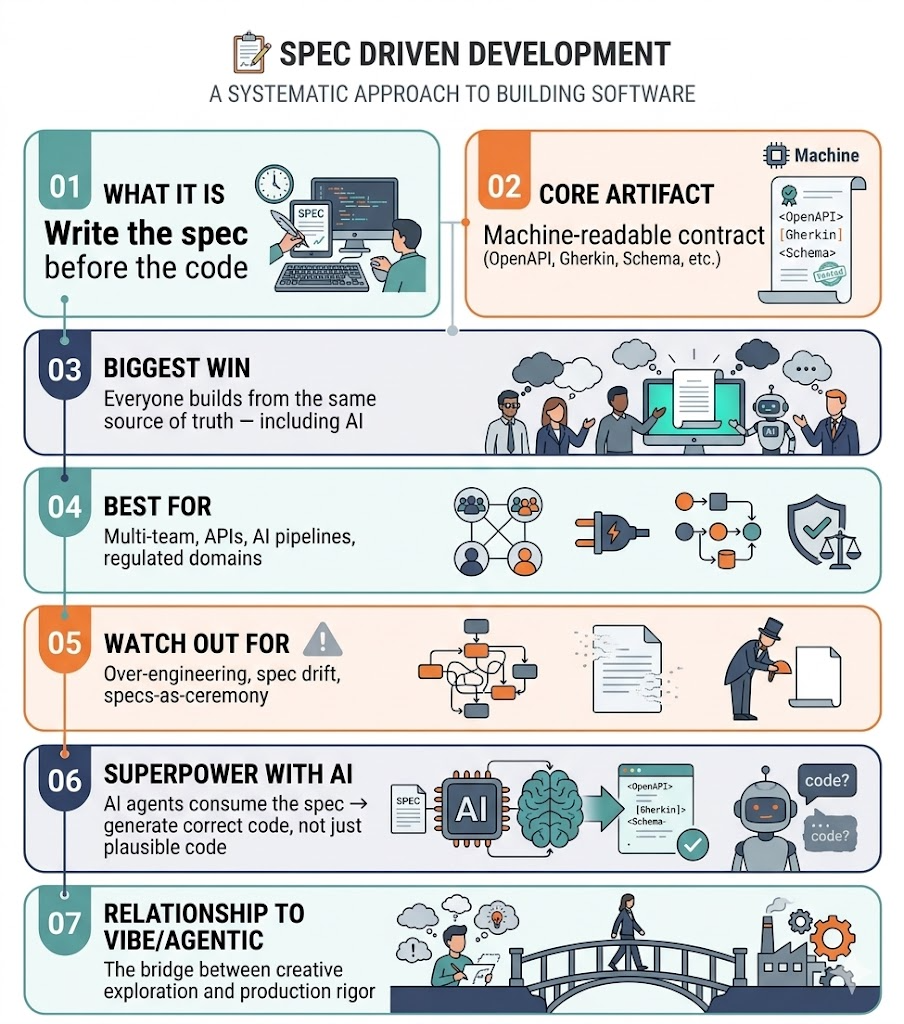
Stop building first and documenting later.
Start specifying first — and let everything else follow.